

Description
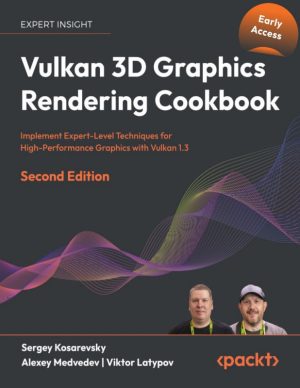
Vulkan 3D Graphics Rendering Cookbook 2nd Edition (Early Access) – Packt Publishing (2024)
Vulkan Graphics Rendering Techniques is a comprehensive learning resource designed for developers who want to master modern real-time rendering with Vulkan 1.3. This advanced cookbook from Packt Publishing helps you build high-performance graphics applications while exploring professional rendering workflows used in modern game engines and visualization systems.
To begin with, the book introduces the Vulkan API architecture and explains how low-level graphics programming works in modern GPUs. Then, it gradually guides you through practical recipes that help you build rendering pipelines, optimize GPU performance, and create visually stunning 3D applications. Moreover, the second edition focuses heavily on Vulkan 1.3 features, bindless rendering, glTF workflows, and GPU-driven rendering systems. As a result, developers can gain practical experience while learning production-level rendering techniques.
Why Learn Vulkan Rendering?
Vulkan has become one of the most powerful graphics APIs for high-performance rendering. Therefore, developers who understand Vulkan can build faster and more scalable rendering engines. In addition, Vulkan provides low-overhead GPU access, which significantly improves rendering efficiency when compared to older graphics APIs.
Furthermore, this cookbook teaches rendering concepts through practical implementation rather than theory alone. Consequently, readers can apply the techniques immediately in game engines, simulation software, AR/VR systems, and graphics applications.
What You Will Learn
- Set up Vulkan 1.3 development environments on Windows and Linux
- Create Vulkan instances, swapchains, and rendering pipelines
- Manage textures, buffers, shaders, and descriptor indexing
- Build physically based rendering (PBR) pipelines using glTF 2.0
- Implement GPU-driven rendering and compute shaders
- Use image-based lighting and HDR rendering techniques
- Optimize rendering performance with advanced Vulkan features
- Develop modern real-time 3D rendering frameworks
Core Topics Covered
The cookbook covers several advanced rendering systems that are commonly used in modern graphics programming. For example, readers will learn about physically based rendering, image-based lighting, HDR rendering, skeletal animations, morph targets, tessellation, GPU culling, indirect rendering, and Vulkan compute pipelines. Additionally, the book explains advanced glTF material extensions and rendering optimizations.
Not only does the book focus on rendering quality, but it also emphasizes performance optimization. Therefore, developers can learn how to render large-scale scenes efficiently while maintaining smooth frame rates.
Who Should Read This Book?
This book is ideal for graphics programmers, game engine developers, AR/VR engineers, and advanced C++ developers interested in GPU programming. Additionally, developers who already understand basic graphics concepts will benefit greatly from the practical Vulkan recipes included throughout the guide.
Although beginners can explore the material, the book works best for intermediate to advanced programmers who already understand linear algebra, rendering basics, and C++ programming concepts.
Explore These Valuable Resources
Explore Related Courses
- Explore Related Courses
- Explore Related Courses
- Explore Related Courses
- Explore Related Courses
- Explore Related Courses
Book Highlights
The second edition introduces several modern rendering workflows that were not fully covered in earlier editions. For instance, readers can explore bindless Vulkan rendering, descriptor indexing, GPU profiling, image-space rendering effects, and compute-driven rendering pipelines. Moreover, the cookbook integrates real-world rendering practices used in modern engines.
In addition, the included GitHub repository provides complete source code examples that help readers experiment with Vulkan implementations directly. Consequently, developers can study real rendering systems and improve their graphics programming skills efficiently.
Conclusion
In conclusion, Vulkan 3D Graphics Rendering Cookbook 2nd Edition is an excellent resource for developers who want to master modern graphics programming and high-performance rendering. Ultimately, the cookbook combines practical Vulkan recipes, advanced rendering concepts, and optimization strategies into one powerful learning package. Therefore, if you want to build professional-grade rendering engines using Vulkan 1.3, this book provides an outstanding learning path.
Source References: Packt Publishing product pages and official GitHub repository. :contentReference[oaicite:0]{index=0}



Reviews
There are no reviews yet.