
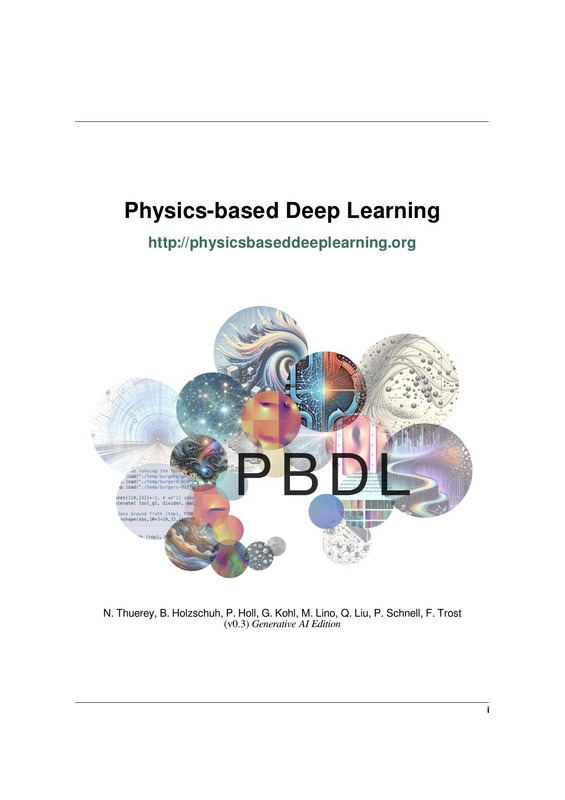
Description
Physics Based Deep Learning
Physics Based Deep Learning combines the power of artificial intelligence with the laws of physics to create intelligent systems that can model real-world phenomena accurately. This advanced learning approach helps researchers, engineers, and data scientists build neural networks that understand physical principles, enabling more reliable simulations, predictions, and scientific discoveries.
Traditional machine learning models often require massive datasets. However, physics-based deep learning improves efficiency by integrating physical laws such as conservation equations, fluid dynamics, and thermodynamics directly into neural networks. As a result, models become more accurate, require less data, and generalize better to real-world applications.
Why Learn Physics-Based Deep Learning?
Today, industries rely heavily on simulation and predictive modeling. Therefore, combining physics with deep learning provides a powerful solution for complex scientific problems. Moreover, this technique allows scientists and engineers to solve problems that traditional simulations cannot handle efficiently.
- Build AI models guided by real physical laws
- Improve simulation accuracy and speed
- Reduce data requirements in machine learning
- Develop intelligent scientific computing models
- Apply AI to engineering, robotics, and climate science
Furthermore, physics-based neural networks are widely used in scientific computing, climate modeling, medical imaging, robotics, and aerospace engineering. Consequently, mastering this field opens many opportunities in research and high-tech industries.
What You Will Learn
This course introduces the core concepts and practical applications of physics-based deep learning. First, learners explore the fundamentals of neural networks and physical modeling. Then, the course gradually moves toward advanced frameworks that integrate differential equations into machine learning systems.
- Foundations of deep learning and neural networks
- Introduction to physics-informed neural networks (PINNs)
- Solving differential equations using AI
- Fluid dynamics simulation with neural networks
- Scientific machine learning techniques
- Training models with physical constraints
- Real-world simulation and prediction systems
In addition, the course includes practical examples that demonstrate how deep learning models can solve complex physical systems. Therefore, learners gain both theoretical understanding and hands-on skills.
Who Should Take This Course?
This course is ideal for learners who want to explore the intersection of artificial intelligence and scientific computing. Specifically, students, researchers, and engineers who work with simulations will benefit greatly.
- Machine learning engineers
- Data scientists
- Physics and engineering students
- Researchers in computational science
- Developers interested in AI-driven simulations
Additionally, anyone interested in advanced AI applications can use this course to deepen their understanding of intelligent modeling techniques.
Career Opportunities
After completing this training, learners can apply physics-based deep learning in many cutting-edge industries. For instance, companies working in autonomous vehicles, aerospace, robotics, and climate modeling actively seek professionals with these skills.
- AI Research Scientist
- Scientific Machine Learning Engineer
- Computational Physicist
- Simulation Engineer
- Deep Learning Specialist
Consequently, mastering this discipline can lead to high-impact roles in both research institutions and technology companies.





Reviews
There are no reviews yet.