

Description
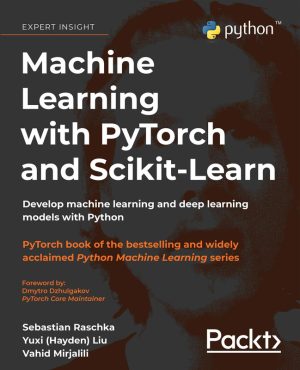
Hands-On Machine Learning with Scikit-Learn and PyTorch
Hands-On Machine Learning with Scikit-Learn and PyTorch equips you to build end-to-end machine learning pipelines, train deep neural networks, and deploy production-ready models using Python’s most popular libraries. From feature engineering and model selection to GPU-accelerated training and serving, this course blends practical recipes with real-world case studies so you can move confidently from notebooks to production systems.
Course overview
Modern ML workflows span classical algorithms and deep learning. You’ll start with scikit-learn for fast prototyping—data preprocessing, model evaluation, and hyperparameter tuning—then transition to PyTorch for building custom neural architectures with autograd, modules, and optimized training loops. Along the way, you’ll integrate experiment tracking, inference optimization, and deployment patterns that meet performance, reliability, and governance requirements.
What you will learn
- Pipeline foundations: data cleaning, feature engineering, and reproducible scikit-learn pipelines.
- Modeling with scikit-learn: linear/logistic regression, tree ensembles, calibration, and cross-validation.
- PyTorch essentials: tensors, autograd, nn modules, optimizers, and training loops.
- Architectures: CNNs for vision, RNNs/GRUs/LSTMs for sequences, and transformers basics.
- Performance and reliability: regularization, early stopping, checkpointing, and mixed-precision training.
- Serving and MLOps: batch vs. real-time inference, model packaging, monitoring, and drift detection.
Curriculum highlights
- Module 1: Data pipelines with pandas and scikit-learn; scaling, encoding, and feature unions.
- Module 2: Model evaluation; metrics, stratified CV, nested tuning, and error analysis.
- Module 3: PyTorch building blocks; dataset/dataloader patterns, training loops, and callbacks.
- Module 4: Computer vision with CNNs; augmentation, transfer learning, and fine-tuning.
- Module 5: Sequence modeling; embeddings, attention, and time-series forecasting strategies.
- Capstone: End-to-end project from raw data to deployed inference API with monitoring.
Explore These Valuable Resources
Explore Related Courses
- Machine Learning Foundations
- Deep Learning Fundamentals
- PyTorch Essentials
- Applied scikit-learn
- Data Science with Python
Who should enroll
- Data scientists: accelerate prototyping and move models into production.
- ML engineers: build robust training pipelines and scalable inference services.
- Developers: integrate ML features into applications with reliable APIs.
- Students and researchers: gain practical skills across classical and deep learning.
Course benefits
By the end of the course, you’ll design reproducible pipelines, train efficient neural networks on GPUs, and deploy models with confidence. You’ll also learn to debug training, interpret results with appropriate metrics, and apply optimization techniques that reduce cost and latency while preserving accuracy.
Prerequisites
- Python basics: functions, packages, virtual environments.
- Math/statistics: linear algebra, probability, and evaluation metrics.
- Tools: familiarity with pandas, NumPy, and Jupyter or VS Code.
Conclusion
Unite the speed of scikit-learn with the flexibility of PyTorch. This hands-on course gives you the patterns and confidence to deliver ML systems that are accurate, efficient, and ready for production.


Reviews
There are no reviews yet.